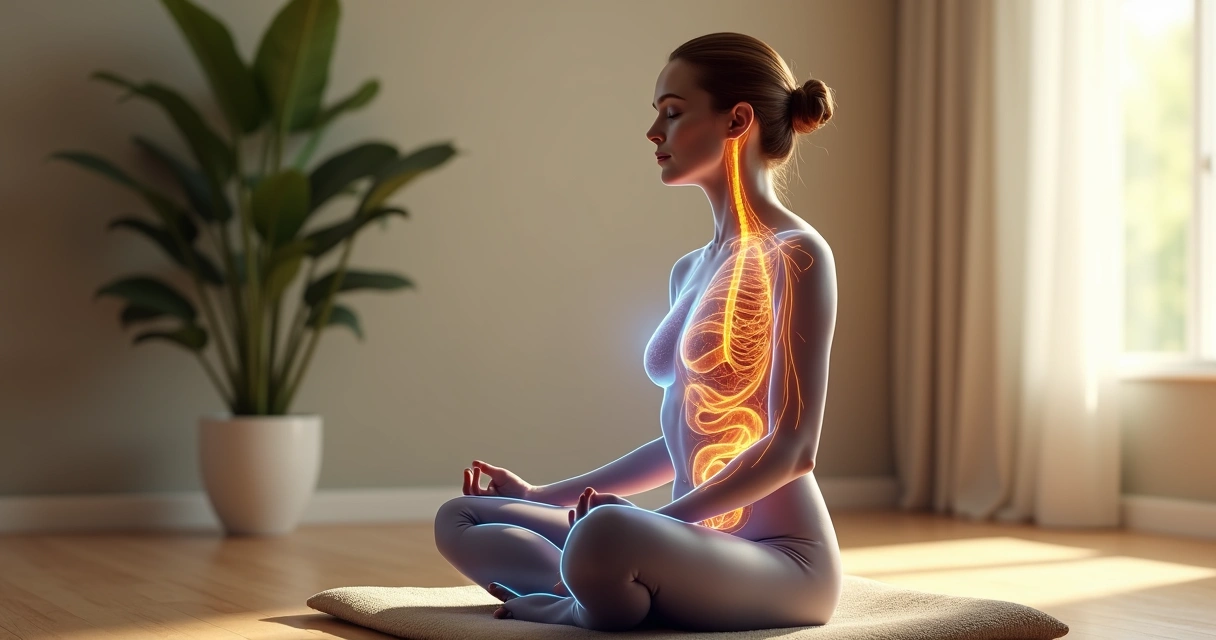

Many of us were taught that calm starts with a big inhale. We feel tense, so we pull in more air. We try again. Bigger. Slower. Stronger. Yet sometimes that effort does not settle us. It makes us feel tight, dizzy, or strangely far from ourselves.
We have seen this often. A person sits down to relax, then starts managing the breath like a task. The chest lifts, the throat stiffens, and the mind becomes busy. The breath is no longer a bridge to awareness. It becomes another demand.
Awareness grows better with listening than with force.
Real awareness in breathing begins when we notice the breath as it is before trying to change it.
This does not mean deep breathing is always wrong. It means depth is not the same as presence. A breath can be large and still disconnected. A breath can be quiet and still bring us back to ourselves. What helps is not only the amount of air. It is the quality of attention.
When deep breaths become effort
Forced breathing often starts with a good intention. We want relief. We want steadiness. But the body reads pressure very quickly. If we command every inhale, we may create more tension in the ribs, jaw, shoulders, and belly.
We think this is why some people say, almost with surprise, “Breathing exercises make me more nervous.” The problem is not always breathing itself. It is the way we approach it.
There are a few common signs that we are forcing too much:
The inhale feels dragged upward into the chest.
The exhale drops out fast, as if we cannot wait to finish.
The throat feels narrow or noisy.
The shoulders rise with each breath.
The mind keeps asking, “Am I doing this right?”
When this happens, less control often helps more than more control. We stop performing calm and start sensing life as it moves.
What subtle shifts look like
Subtle shifts are small changes in attention, posture, and timing that help the breath become easier without pushing it. They are not dramatic. In fact, they can feel almost too simple at first.
A subtle shift does not force a new breath pattern. It creates the conditions for the breath to soften on its own.
Here are a few shifts we return to often:
Notice the exhale first. Instead of trying to take a fuller inhale, we let the exhale finish without rush. This alone can reduce effort.
Soften the mouth and jaw. A hard jaw often comes with a hard breath. Releasing the face can change the whole rhythm.
Widen attention. We feel the breath, but also the feet, hands, and contact with the chair. This prevents over-fixation.
Lower the goal. We stop trying to feel perfect. We only try to feel present.
These shifts look small from the outside. Inside, they can change everything.

Why gentler attention works
When we stop pushing, we begin to pick up details that were hidden by effort. We notice where the breath catches. We notice whether the inhale starts high in the chest or low in the torso. We notice emotion. Sometimes sadness. Sometimes irritation. Sometimes plain fatigue.
This is where awareness becomes honest.
In our view, breathing is not only a tool for calming down. It is also a way of meeting what is already here. If we use breath only to escape discomfort, we may miss what the body is trying to show.
That is why gentler methods can still be powerful. A 6 week connected-breathwork program that showed a large drop in anxiety points to the impact breathing practices can have. Still, even with promising results, we think practice becomes more stable when intensity is matched with sensitivity. More air is not always more awareness.
Calm is often supported by permission, not pressure.
Simple ways to practice during the day
We do not need a perfect room, a long session, or a special mood. Real awareness is built in plain moments. One minute can be enough when the attention is clear.
A short practice might look like this:
Sit or stand without trying to “fix” posture too much.
Feel where your body touches the floor, seat, or wall.
Notice one natural breath without changing it.
Let the next exhale become a little less hurried.
Pause and sense the body as a whole.
That is enough. Truly.
We have found that people often expect awareness to arrive with intensity. But many of the clearest moments come quietly. Waiting at a red light. Washing a cup. Sitting before a hard conversation. In those moments, one less forced inhale can create more honesty than ten heroic ones.
What gets in the way
Sometimes we force deep breaths because we are trying to outrun inner noise. Sometimes because we believe visible effort means progress. And sometimes because advice has been oversimplified into one message: just breathe deeply.
But breathing is personal. Context matters. A person under stress, a person with grief, and a person recovering from panic may not respond well to the same instruction. We need room for variation.
It helps to watch for these habits:
Turning every breath into a correction.
Chasing a calm state instead of noticing the present state.
Ignoring signs of strain, lightheadedness, or agitation.
Believing quiet breaths are weak breaths.
One afternoon, after a long day, one of us caught that exact pattern. The breath was big, loud, and not relieving anything. We stopped, let the next exhale fall naturally, and felt the feet on the floor. The breath became smaller. The body became clearer. Not dramatic. Just true.

Conclusion
We do not have to overpower the breath to become aware. In many cases, the opposite is closer to the truth. When we stop forcing depth, we begin to notice rhythm, tension, space, and feeling. That is where real awareness starts.
The breath is not asking us to dominate it. It is asking us to meet it.
Less force. More contact.
If we make one shift today, let it be this: before taking a bigger breath, take a more honest look. The body often knows the next step when we stop interrupting it.
Frequently asked questions
What is real awareness in breathing?
Real awareness in breathing is the ability to notice the breath as it happens, including its pace, texture, pauses, and areas of tension, without rushing to control it. It includes sensing the body, emotion, and attention at the same time. It is less about making the breath perfect and more about being present with it.
Why avoid forcing deep breaths?
Forcing deep breaths can create strain in the chest, throat, jaw, and shoulders. It may also increase self-monitoring and make some people feel more anxious or lightheaded. A gentler approach often helps the nervous system settle because the body does not feel pushed.
How can I become more aware?
We can become more aware by starting small. Feel the contact of the feet with the floor, notice one natural inhale and exhale, and allow the breath to move without correction for a few moments. It also helps to widen attention beyond the lungs and include the whole body.
Are deep breaths always helpful?
No. Deep breaths can help in some situations, but not in all of them. For some people, especially during stress or panic, bigger breaths may feel unnatural or overstimulating. What helps most depends on the moment, the body, and the quality of attention we bring.
What are subtle shifts in breathing?
Subtle shifts are small changes that reduce effort and increase contact with the present moment. They include softening the jaw, letting the exhale finish fully, relaxing the shoulders, and noticing the body as a whole. These shifts do not impose a pattern. They allow a steadier breath to appear naturally.